dcplusplus.3xforum.ro
clienti dc++ download ldcc 2.0.7 (Linux) iDC++ 2.02 fulDC 6.76 PhantomDC 0.306 zDCPlusPlus 0.668 (Ita) rmDC++ 0.403 (Recommended) StrongDC 2.03 odc 5.31 DC++ 0.698 DC++ 0.699
servere hub
|
Lista Forumurilor Pe Tematici
|
dcplusplus.3xforum.ro | Inregistrare | Login
POZE DCPLUSPLUS.3XFORUM.RO
Nu sunteti logat.
|
Nou pe simpatie:
simpatica_dorina pe Simpatie
 | Femeie
25 ani
Arad
cauta Barbat
32 - 44 ani |
|
|
tiberiu
Administrator
Inregistrat: acum 19 ani
Postari: 108
|
|
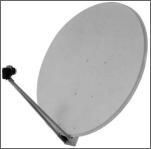
Offset satellite antenna is a section of a paraboloidal reflector with oval form. The antenna surface is not round anymore, but oval (ellipse) and symmetric. The focal point is not mounted in the middle of the dish, but to the side of the dish (offset). Thus, the advantage of this technology, is that the antenna surface is not being shadowed by the feed anymore (from the satellite's point of view).
Another advantage is the less likelihood that snow will build up on the dish. The offset satellite antenna does not "look" straight up to the satellite as a Prime Focus antenna does, but it's inclined about 25° downward (almost upright position). Nevertheless, an offset dish appears for the satellite to be circular having the horizontal diameter.
3.5KB
|
|
| pus acum 18 ani |
|
|
tiberiu
Administrator
Inregistrat: acum 19 ani
Postari: 108
|
|
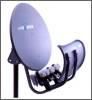
Antennă Multibeam
WaveFrontier Toroidal antenna
TOROIDAL dual reflector antenna is similar to Gregorian reflector in shape, but the basic formula differs from it. The sub-reflector of Toroidal antenna is from a virtual toroid, but the main reflector is analogous to an ellipsoid. There is no parabolic formula. This system has a convex - concave sub-reflector. This sub-reflector is convex in one plane and concave in orthogonal plane. The complete shape of them are obtained through elaborate mathematical and physical calculation.
Sursa: Wave Frontier Co.
[url]http://www.multilnbdish.com/technology.htm
3.1KB
|
|
| pus acum 18 ani |
|
|
tiberiu
Administrator
Inregistrat: acum 19 ani
Postari: 108
|
|
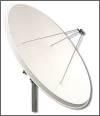
Antennă Prime Focus (PFA)
The Prime Focus Antenna (parabolic antenna) is a satellite antenna which is perfectly round. It is absolutely symmetric built and has a parabolic shape. The focal point is in the middle of the dish. That's why the LNB is mounted centrally at the focus, where it can collect all incoming signals. Such a satellite antenna is typically larger than 1.2 meters.
Advantages:
Because of its relatively large surface, the prime focus antenna is less sensitive to small directional deviations and there is a better chance of receiving signals outside the normal footprint. But on the other hand, because of the small beamwitdh (3dB) angle, the antenna has to be setup more accurate than a normal offset one.
Disdvantages:
Rain and snow can easily collect in the dish and could interfere with the signal.
Because of the LNB is mounted centrally, a lot of the incoming signals are blocked by the LNB on the way to the antenna surface. But if using only a Ku band feed, the shadow won't be that big as when using a C band feed.
Further forms of Prime Focus antennas are Mesh, Cassegrain and Gregory.
The Mesh dish is a special form of the Prime Focus Antenna. A Mesh dish is made up of some kind of reticule. Just like the normal PFA, a Mesh dish is being used for C band reception using an Egis rotor.
2.7KB
|
|
| pus acum 18 ani |
|
|
tiberiu
Administrator
Inregistrat: acum 19 ani
Postari: 108
|
|
Antennă planară
The flat antenna is an alternate antenna design called 'planar array'. It's the most compact and visually the least obtrusive type of antenna for satellite reception.
Since a flat antenna requires very less space for mounting (no external LNB existent), it is dedicated for those who have no possibility to use greater antennas, those who are not allowed to mount a normal parabolic satellite dish at all or more often for campers. The biggest advantage of this antenna type is the fact, that it is very unobtrusive.
The antenna will deliver good signal quality only if you are in the main footprint area of the desired satellite, so that you can have the full signal strength. In other words, it has to be used with powerful satellites.
One main disadvantage of the planar array is its limited restriction to the reception of a single satellite or constellation of collocated satellites like Astra at 19.2° East or Hotbird at 13.0° East.
3KB
|
|
| pus acum 18 ani |
|